Over the past few years, a clear pattern has emerged in the work we do at Ibanista. When clients ask us to help them find a long-term rental or search for a property in France, one city comes up more consistently than anywhere else. Not Paris. Not Lyon. Not Nice. Bordeaux.
And here is what is interesting about that: it is not because Bordeaux is the cheapest city in France, or the sunniest, or the most internationally famous. It is because Bordeaux manages to get an unusual number of things right simultaneously, in a way that very few French cities do. For Americans in particular, something about the combination clicks.
This is our honest attempt to explain why.
Table of contents
Big-city life without Paris
When Americans tell us they want to move to France, they usually mean they want a particular kind of life: good restaurants, culture, reliable public transport, quality healthcare, an international airport. What they do not mean, even when they think they do, is Paris. At least, not once they have spent a few months there.
Paris is extraordinary. It is also expensive, dense, fast, and genuinely exhausting to live in as a newcomer navigating a new administrative system in a language you are still learning. The learning curve is steep, the rental market is brutal, and the scale of the city can swallow you before you find your footing.
Bordeaux offers almost everything Paris does in terms of practical infrastructure, and then gives you room to breathe. It is a city of around 260,000 people in its urban core, large enough to have everything you need, small enough that you can understand it within a few months. The tram system is excellent. The restaurant scene is genuinely serious. The healthcare infrastructure is strong. And the rental market, while competitive, is not the gauntlet Paris presents.
Bordeaux sits in the sweet spot between “too small to have what you need” and “so large you never feel like you live there.”
Four seasons that most Americans actually recognise
Climate matters more than people admit when they are choosing where to live. It shapes energy levels, how much time you spend outdoors, how your home feels in winter, and whether you end up loving or resenting the place you chose.
Bordeaux has a genuinely pleasant Atlantic climate. Warm summers, not punishing ones. Mild winters, cold enough to feel seasonal, not cold enough to be miserable. A meaningful amount of sunshine year-round. Occasional rain, particularly in autumn and winter, but nothing like the relentless grey of northern France or Belgium.
For Americans from the Northeast, New York, Boston, Connecticut, Massachusetts, this feels immediately recognisable. A proper summer. A proper autumn. A winter that is manageable rather than brutal. For those from the Pacific Northwest, the milder version of that familiar damp-and-grey pattern, but with considerably more sun. For Californians, it is a different kind of warmth, but the general orientation toward outdoor life feels familiar.
What you are actually buying access to
One thing we say to clients regularly: you are not just buying a city. You are buying access. And what Bordeaux gives you access to is, on any honest assessment, exceptional.
The TGV connection to Paris in around two hours means you have the capital available whenever you need it, for appointments, for meetings, for a museum, for an airport connection, without living there. The Atlantic coast is close enough for regular day trips, which matters more than people expect once they discover how different the quality of life feels when the beach is an hour away rather than four.
And the wine regions. We mention this not because it is a cliché but because the Bordeaux wine landscape, the Château Médoc, the Graves, the Saint-Émilion circuit, genuinely becomes part of daily life in a way that is surprising even to people who were not particularly interested in wine before they arrived. Weekend visits, harvest dinners, impromptu estate tastings. It becomes part of how you inhabit the place.
It feels more French than Paris
This sounds counterintuitive, but it is something we hear consistently from clients who have spent time in both cities. Paris is France’s capital, but it is also one of the most international and expensive cities in Europe, and daily life there does not always match the image of France that brought people to the country in the first place.
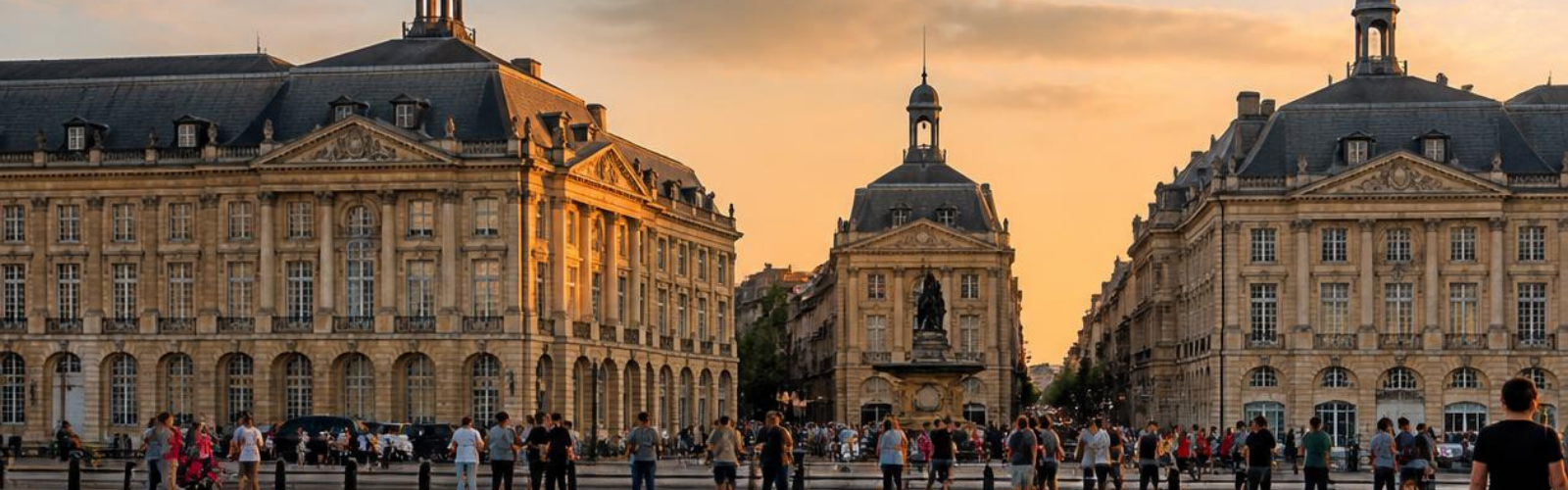
The image most Americans have of France is markets, cafés, limestone architecture, walking everywhere, riverside life, a certain pace, a certain quality of daily ritual. Bordeaux delivers all of that, uninterruptedly, without the overlay of hyper-tourism that shapes so much of Paris at street level. The marchés des Capucins, the Place Saint-Pierre, the Quai des Marques riverside, these are places that real people use, daily, as part of an ordinary life. The architecture of the 18th-century centre is magnificent and consistent in a way that Paris, for all its beauty, is not.
Bordeaux also has a provincial quality of social life, unhurried, neighbourhood-focused, built on regular presence in the same places, that matches what most people are actually seeking when they say they want to move to France.
City and wilderness, genuinely close
One of the things that is hardest to convey on paper about Bordeaux is the variety of natural landscape available within a reasonable drive. This is not a small thing. One of the most common regrets we hear from people who choose dense urban cities is that they never quite get out of them. Life fills up. The weekend trip to the countryside that seemed so appealing becomes the thing you will do next month.
Bordeaux does something unusual: it makes nature accessible enough that you actually go. Within an hour, depending on direction, you can be in the Landes forest (Europe’s largest maritime pine forest), on the Atlantic beaches at Lacanau or Arcachon, in the vineyards of the Médoc, hiking the Dordogne cliffs, or sailing on the Bassin d’Arcachon. Most clients who move to Bordeaux start exploring the southwest within their first few months in a way that would simply not happen if they were living in Paris or Lyon.
Medical infrastructure that actually matters
This is a section that matters most to retirees, but it applies to everyone. France’s healthcare system is excellent in most of the country, but access to specialists, private clinics, and major hospital infrastructure genuinely varies by region. Some rural areas require long drives for anything beyond GP-level care.
Bordeaux has a major teaching hospital, the CHU de Bordeaux, along with a network of specialists, private clinics, and well-staffed GP practices. For someone managing a chronic condition, dealing with the natural health concerns of retirement, or simply wanting the reassurance of real medical infrastructure within easy reach, this matters. It is one of the reasons Bordeaux works for retirees in a way that, say, rural Dordogne, beautiful as it is, does not always replicate.
International without feeling like an expat bubble
One of the tensions we hear in almost every client conversation is this: people want French life, but they do not want to feel isolated. They want to integrate, to make French friends, to build a life in French, and they also want the occasional conversation in English, access to a community of people who understand the bureaucratic struggle of moving from another country, and the option of an English-speaking doctor when something is genuinely urgent.
Bordeaux navigates this tension better than most French cities. It has a visible international community, Americans, British, Dutch, Australians, and a range of other nationalities, without that community dominating the city’s character. You can find English-speaking professionals, international schools, expat social groups, and community events when you need them. But Bordeaux does not feel like a British-in-France enclave the way parts of the Dordogne can, and it does not have the impenetrable tourist veneer that can make integration in the most famous destinations feel surprisingly difficult.
The expats who settle most successfully in Bordeaux, or anywhere in France, are the ones who use the international community as a landing pad, not a destination. The friendships and practical knowledge available from other expats are genuinely valuable in year one. The goal, for most people, is to gradually expand beyond that into a life that is genuinely rooted in the place. Bordeaux makes that progression feel natural rather than forced.
Better value than Paris and more of it
Bordeaux is not cheap. It is a major French city, and property and rental prices reflect that. But compared to Paris, the value difference is significant, and what that buys you in practice is not just money saved but quality of life gained.
In Paris, your budget might get you a small apartment in an area you chose largely because it was what you could afford. In Bordeaux, the same budget typically buys a larger property, in a neighbourhood you actually want to be in, often with outdoor space. For families, the calculation is particularly compelling: a three-bedroom apartment in Bordeaux that would be a luxury in Paris is accessible here without significant financial stretch.
- Buying: Bordeaux centre averages considerably less per square metre than comparable Paris arrondissements, with wide variation by neighbourhood, Chartrons, Bastide, Bacalan, and the historic centre all have distinct price points
- Renting: a furnished one-bedroom in a good neighbourhood typically runs between 900 € and 1,600 € per month depending on size and exact location, competitive, but not the gauntlet the Paris rental market presents for expat applicants
- The dossier: the same challenge around foreign income and GLI insurance applies in Bordeaux as elsewhere in France; but the slightly less pressured market means there is more room for a strong, well-prepared application to succeed
Bordeaux as a first year in France
There is a reason we often recommend Bordeaux specifically for people in their first year of living in France. And it is not just the practical reasons we have covered above, though those matter. It is something more strategic.
Your first year in France is not really about finding your forever home. It is about learning what your forever home should look like. You need to understand the administrative system while still being close enough to support if something goes wrong. You need to build your French from a starting point of regular, varied, daily exposure, Bordeaux provides that far better than a small rural village where you may go days without a French conversation that challenges you. You need to understand the rhythm of French life, the bureaucracy, the healthcare system, the banking, the seasons, from a position of infrastructure and community, not isolation.
Bordeaux gives you all of that. It also gives you a base from which to explore the entire southwest, the Dordogne, the Pyrenees, the Atlantic coast, the Basque Country, so that by the end of year one, you have a genuinely informed view of whether you want to stay in the city, move to something smaller nearby, or explore another region entirely.
Your first year in France isn’t about finding your forever home. It’s about learning what your forever home should look like. For many of our clients, Bordeaux isn’t the final destination, it is the city that gives them the confidence to decide where that destination should be. And for a significant number, it turns out to be the final destination anyway. Not because they couldn’t find anything better. Because they stopped looking.