If you’re dreaming of buying a house in rural France, you’re not alone. More and more British and American buyers are looking beyond Paris and the Riviera for better value, a slower pace of life, and long-term quality of life.
The good news: many rural areas still offer realistic prices and room to negotiate, especially if you’re flexible on location and ready to do a bit of homework.
Below, we’ll walk through five of the best rural regions to buy a property in France if you’re an expat: what life feels like, typical activities, cost of living, and current property price ranges.
Table of contents
Why look at rural France as an expat buyer?
Before we dive into regions, it’s worth being clear about why rural France works so well for many expats:
- Better value per m² than Paris, the Côte d’Azur, or the Basque coast
- Space and privacy, gardens, outbuildings, room for guests
- A genuinely French everyday life, not just a tourist version
- Access to local markets, healthcare, and schools, often closer than you’d expect
Brittany
Best for: coastal scenery, village life, and relatively affordable property
Brittany (Bretagne), in northwest France, is a favourite with expats who want sea air, strong local identity, and prices that are still reasonable compared to the south.
Lifestyle, tourism & activities
Brittany offers a mix of:
- Long, wild coastlines and sandy beaches
- Harbours, fishing villages and working ports
- Medieval towns like Dinan, Vannes, Quimper
- Strong Celtic culture, music and festivals
Day-to-day, life can be very local: weekly markets, small cafés, coastal walks, sailing, and a solid off-season community (not just summer tourists).
Cost of living
Compared with France’s most expensive coastal zones (Côte d’Azur, Basque coast, Var), Brittany is still relatively affordable:
- Everyday costs are close to the national average
- You can live near the coast without paying Riviera money
- Heating costs matter, winters are damp and fresh, but services and shops are usually close by even in rural areas
Property prices in Brittany
As of late 2025:
- Typical house prices: around 2,000–2,400 €/m² in many parts of Brittany
- Prime coastal hot-spots: easily 5,000 €/m²+ in very sought-after seaside towns
You’ll find everything from granite cottages and longères (traditional farmhouses) to renovated village houses and small manors. If your budget is under 150,000 €, you’ll often be looking a little inland rather than on the water.
Provence-Alpes-Côte d’Azur
Best for: buyers who want sun, scenery, and are realistic about higher prices
Provence-Alpes-Côte d’Azur (PACA) covers the Mediterranean coast, the Provençal hinterland, and part of the Alps. It’s one of the most recognisable postcards of France, and one of the most expensive.
Lifestyle, tourism & activities
In rural PACA you get:
- Lavender fields, vineyards, olive groves
- Hilltop villages (Gordes, Roussillon, Bonnieux, etc.)
- Weekend markets, Provençal cuisine, and strong local food culture
- Easy access to mountains and sea if you pick the right spot
It’s a region where seasonality is strong: intense summers, quieter winters, and a lot of second-home owners in certain villages.
Cost of living
Let’s be honest: PACA is not a low-cost region.
- Everyday life (restaurants, services, tradespeople) is typically above the national average
- Coastal areas, especially on the Côte d’Azur, are among the highest price points in the country
- The good news: move inland, away from Nice, Cannes and Saint-Tropez, and prices become more accessible
Property prices in PACA
As of late 2025:
- Median price (all property): around 4,250 €/m²
- Prime coastal communes: often 5,000–7,000 €/m²+
For expats, the sweet spot is often:
- A stone village house or small mas inland
- Good road access to a larger town
- Not in the most famous “magazine” villages but in the next ring out
You’re paying for sun, scenery, and international demand, not just bricks and mortar.
Dordogne
Best for: British buyers, food lovers, and anyone who wants charm at a sane price
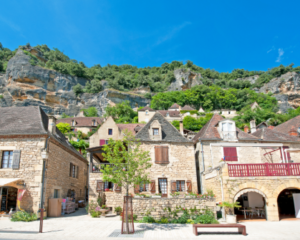
Dordogne, in south-west France (often called Périgord), is a long-time favourite with international buyers. It combines rural calm with tourism infrastructure and a very active expat community in certain valleys.
Lifestyle, tourism & activities
Expect:
- Medieval towns like Sarlat-la-Canéda
- Rivers (Dordogne, Vézère) for canoeing and swimming
- Châteaux, caves, markets, and a serious food culture
- Truffles, walnuts, foie gras, Bergerac wines
Outside of the main tourist hubs, daily life is quiet, village-centred and strongly seasonal.
Cost of living
Dordogne is still moderately priced compared with many other “pretty” regions:
- Eating well at home is relatively cheap thanks to local produce
- Council taxes and daily costs are often manageable for retirees
- You do need to factor in car dependence, public transport is limited in rural areas
Property prices in Dordogne
As of 2025:
- Average house prices: roughly 1,800–1,900 €/m²
- Tourist hot-spots (e.g. Sarlat, riverfront villages): higher, especially for well-renovated stone properties
You’ll see a lot of:
- Stone farmhouses with barns and land
- Small manors with character features
- Village houses that need updating but have solid bones
For many expats, Dordogne is where the France-in-your-head and the budget-on-paper finally meet.
Auvergne
Best for: nature lovers, hikers, and buyers who prioritise space and value over glamour
Auvergne sits in the middle of France, built around the Massif Central and its extinct volcanoes. It’s wild, green, and far less “marketed” internationally, which is exactly why many people love it.
Lifestyle, tourism & activities
Auvergne is ideal if you want:
- Hiking, cycling, lakes, and outdoor sports
- Volcanic landscapes (Puy de Dôme, Chaîne des Puys)
- Quiet villages with real year-round communities
- Snow in winter, fresh air in summer
Tourism exists, but it’s more French weekenders and hikers than international tour buses.
Cost of living
Rural Auvergne remains one of the more affordable parts of France:
- Prices in small towns and villages are well below national averages
- Services are more spread out, so a car is non-negotiable
- For retirees or remote workers who don’t need a big city nearby, it can be extremely cost-effective
Property prices in rural Auvergne
As of 2025:
- In many villages and small towns, houses sit around 1,500–2,000 €/m²
- Still significantly cheaper than the Alps or major cities in the wider Auvergne-Rhône-Alpes region
Typical properties include:
- Rustic farmhouses with stone façades and beams
- Barn conversions with big volume and views
- Simple village houses with potential and large gardens
If you’re comfortable being a little “off the main map”, Auvergne is where space, budget and calm come together.
Occitanie
Best for: buyers who want south-of-France weather without Riviera prices
Occitanie covers a huge area in the south: Pyrenees mountains, Mediterranean coast, big agricultural plains, and historic cities like Toulouse and Montpellier.
Lifestyle, tourism & activities
Depending on where you buy, you can have:
- Mountain life near the Pyrenees (skiing, hiking, cycling)
- Mediterranean beaches near Béziers, Perpignan, Montpellier
- Vineyards across Languedoc and beyond
- Historic sites like Carcassonne’s medieval fortress
Everyday life can be as rural or as semi-urban as you choose, the region is very varied.
Cost of living
Occitanie offers a good compromise:
- Many inland areas are close to or below the national average for costs and property
- Coastal belts and city centres are more expensive but still often cheaper than the Côte d’Azur
- Climate is kinder to heating bills than the north or centre
Property prices in Occitanie
As of 2025:
- Regional averages sit around 2,400–2,700 €/m²
- For houses alone, many sources put typical prices near 2,200 €/m², with rural and inland communes below that
- Seaside and city locations (Montpellier, some parts of Aude/Hérault, Perpignan) trend higher
Common property types:
- Village houses in wine-growing areas
- Renovated farmhouses with land
- Stone houses in small market towns with good services
For many expats, Occitanie delivers the southern lifestyle with more realistic entry prices than PACA.
How to choose the best rural region to buy in France
Once you’ve fallen in love with the idea of rural France, the key is to get practical. Here’s how to narrow it down.
Clarify your lifestyle priorities
Ask yourself:
- Do you want to be near the sea (Brittany, Occitanie, parts of PACA)?
- Or is it more about land, views and walking (Auvergne, Dordogne)?
- Do you need an active expat community, or are you happy being one of only a few foreigners locally?
Your answers will eliminate entire regions very quickly.
Match region to budget
Broadly, in 2025:
- Most expensive of the five: PACA (especially the Côte d’Azur)
- Mid-range: Brittany, Occitanie (depending on proximity to coast/cities)
- More affordable: Dordogne
- Often cheapest: rural Auvergne
If your maximum budget is tight and you don’t want a full renovation, Dordogne, inland Occitanie, or Auvergne are usually better hunting grounds than Provence.
Check access, not just the view
In rural France, you need to factor in:
- Distance to hospital / medical centre
- Train stations and nearest airport (for regular trips back to the UK/US)
- Schooling if you have children
- Year-round shops and services (not just summer businesses)
A beautiful hamlet 40 minutes from everything can be perfect for some, and isolating for others.
Think long-term, not just “holiday mode”
If you’re planning to live in France full-time, ask:
- What is winter like here?
- How busy is it in November, not August?
- Does the village feel alive year-round?
A house that works as a holiday bolthole doesn’t always work as a primary residence.
Final notes
Whether it’s lavender in Provence, stone villages in Dordogne, wild coastlines in Brittany, big skies in Auvergne, or vineyards in Occitanie, rural France gives you real options as an expat buyer:
- More space for your budget
- A chance to plug into local communities
- Long-term quality of life that isn’t dependent on trends or tax gimmicks
The right region is the one that fits your budget, lifestyle, and long-term plans, not just the prettiest photo on Instagram.
Updated November 2025
Planning a move to France or just thinking about it?
Book a free 30-minute call with our team for personalised guidance on relocating to France. 👉 Schedule your call here
Not ready for a call? No problem. Explore our free resources to learn at your own pace:
📚 Browse the blog for expert tips
🎧 Listen to our podcast for real stories and insights
Wherever you are in your France journey, we’re here to help.